
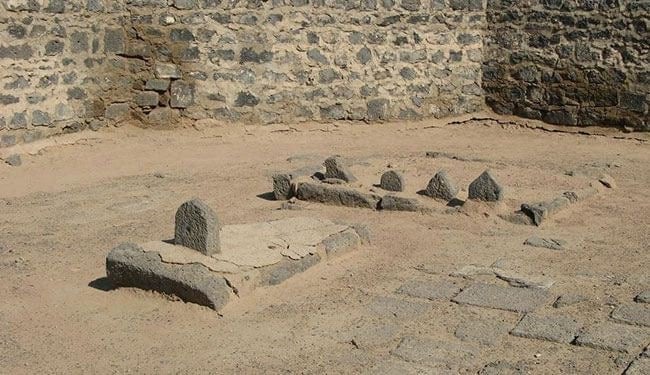
Imam Sadiq (as) was born in Medina Munawwarah on the 17th of Rabi' al-Awwal, 83 AH, and was martyred on the 25th of Shawwal, 148 AH. Thus, his total age was 65 years. Imam Sadiq (as) spent 12 years under the guidance of his illustrious grandfather and 19 years alongside his respected father. His own period of Imamate (leadership) lasted 34 years. His Imamate coincided with the reigns of the following Umayyad caliphs: Hisham bin Abdul Malik, Walid bin Yazid bin Abdul Malik, Yazid bin Walid (known as Al-Naqis), Ibrahim bin Walid, Marwan Al-Himaar. Following this, power shifted from the Umayyad Dynasty to the Abbasids. After Abul Abbas as-Saffah, the Imam also witnessed the era of Mansur al-Dawaniqi. Ultimately, the Imam’s martyrdom occurred through the poison of oppression administered by this same Mansur al-Dawaniqi. He was subsequently buried in the Baqi Cemetery in Medina alongside his ancestors1.
Allah the Almighty says in the Holy Quran:
هُوَ الَّذِي بَعَثَ فِي الْأُمِّيِّينَ رَسُولاً مِنْهُمْ يَتْلُوا عَلَيْهِمْ آياتِهِ وَ يُزَكِّيهِمْ وَ يُعَلِّمُهُمُ الْكِتابَ وَ الْحِكْمَةَ وَ إِنْ كانُوا مِنْ قَبْلُ لَفِي ضَلالٍ مُبِينٍ2
It is Allah Who has raised among the unlettered people a Messenger from among themselves, who recites His revelations to them, purifies them, and teaches them the Book and wisdom whereas before this, they were clearly lost in error.
In the aforementioned verse, Allah the Almighty identifies the purpose of the Prophet’s (saww) mission as the purification (Tazkiyah) and education of the people. Certainly, this was also the objective of his successors. However, whenever the Caliphate was snatched from the Ahl al-Bayt (the Prophet's Household), they were kept distanced from society. As a result, the Muslims of the world were gradually deprived of both intellectual and practical training. Yet, when the struggle for the Caliphate broke out between the Umayyads and the Abbasids, Imam Baqir (as) took advantage of this window of opportunity for a period, followed by Imam Sadiq (as) who did so openly. Focusing fully on the Prophet’s mission the education and training of society he laid the foundation for an expansive Islamic University. This institution held classes in various branches of both Rational Sciences (Uloom-e-Aqli) and Narrated Sciences (Uloom-e-Naqli). Within it, he trained disciples such as Hisham bin Hakam, Muhammad bin Muslim, Aban bin Taghlib, Hisham bin Salim, Mufaddal bin Umar, and Jabir bin Hayyan... eventually reaching a total of approximately four thousand students.
During the era of Imam Sadiq (as), various religious sects such as the Mu'tazila, Jabriyya, Murji'ah, and Ghulat (extremists) had already emerged. These groups were not only preaching their religious deviations but were also attempting to corrupt the beliefs of the people by spreading doubts and misconceptions. In addition to addressing all these schools of thought, Imam Sadiq (as) actively defended and promoted authentic Islam. To achieve this, he utilized a dual strategy: Academic Outreach: He trained talented individuals in specialized fields within academic centers to communicate the true essence of the faith. Intellectual Defense: He defended Islam through formal debates (Munazarah) to counter the arguments of these sects3.
For example, during the eras of Imam Baqir (as) and Imam Sadiq (as), the activities of the Ghaliyan (Extremists) were at their peak. Through their exaggeration (Ghuluw), they attributed the status of divinity (Rububiyat) to the Imams. In this situation, Imam Sadiq (as) vehemently rejected these exaggerations and strictly forbade people from associating with them. He regarded them as disbelievers (Kafir) and polytheists (Mushrik); for this reason, he even prohibited the Shias from so much as shaking hands with them4. Consequently, Imam Sadiq (as) warned the Shia youth about this deviant ideology, saying: Be vigilant, lest the extremists (Ghaliyan) corrupt your youth. They are the worst enemies of Allah, for they diminish the greatness of Allah and attribute divinity (Rububiyat) to the servants of Allah5. Similarly, when Abu Hanifa popularized the practice of Qiyas (analogical reasoning), the Imam repeatedly drew a line of cancellation (Khat-e-Butlan) over this theory to restrain him from this deviant thought. Allah the Almighty provided Imam Sadiq (as) with this golden opportunity to openly discuss all aspects of the authentic Islam which had reached him through the Prophet (saww) and Amir-ul-Mu'mineen (as) and to illuminate its jurisprudential features (Fiqhi khado-khaal). This is precisely why, today, our school of thought is attributed to him and is called Fiqh-e-Jafari.
Here, we briefly outline the unique characteristics and merits of Fiqh-e-Jafari:
We conclude this article with the testament of Imam Ja'far al-Sadiq (sa), which he addressed to his followers (Shias), stating:
إِنَّهُ لاَ یَنَالُ شَفَاعَتَنَا مَنِ اسْتَخَفَّ بِالصَّلاَةِ6
Our intercession (Shafa'at) will not reach the person who considers the prayer (Namaz) to be unimportant.
May Allah the Almighty grant us all the guidance (Tawfiq) to become establishers of prayer and to be included among those who pray. Ameen.
1Saduq, Al-I'tiqadat, 1413 AH, p. 98
2Surah Al-Jumu'ah, Verse 2
3Seerat-e-Pishvayan, p. 355
4Rijal al-Kashshi, 1409 AH, p. 300
5Shaykh Tusi, Al-Amali, 1414 AH, p. 650
6Al-Kafi, Vol. 3, p. 270